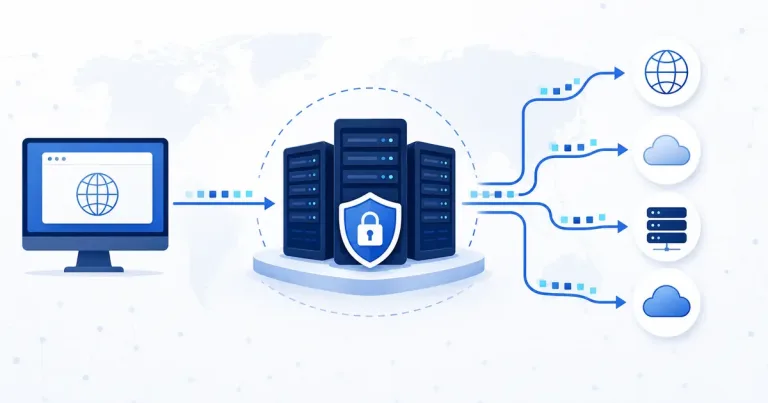
Datacenter proxy guide for 2026

What Are Datacenter Proxies? How They Work, Benefits and Uses

Datacenter proxies are IP addresses hosted on servers in commercial datacenters rather than assigned through a residential internet connection. They route supported application traffic through a proxy server, so the destination sees the proxy IP instead of the client connection's public IP.

Server-hosted IPs Static or rotating HTTP/HTTPS or SOCKS5 Business workflows
Definition

What Is a Datacenter Proxy?

A datacenter proxy is a proxy endpoint using an IP address announced by a hosting, cloud or datacenter network. Unlike a residential proxy, its IP is not supplied by a household internet service. Unlike a mobile proxy, it is not routed through a mobile carrier connection.

The word datacenter describes where the IP and proxy service originate; it does not tell you whether the proxy is dedicated, shared, static or rotating. Those are separate product characteristics that should be checked before ordering.

HighProxies service scope: HighProxies provides static datacenter IPv4 proxy services, including dedicated HTTP/HTTPS packages and separate SOCKS5 plans. We do not sell residential or mobile proxies.

Datacenter IP Address

The destination receives the public IP of the proxy server rather than the public IP used by your local connection.

Server Infrastructure

The proxy runs on professionally hosted infrastructure with datacenter network connectivity and controlled server resources.

Defined Location

Providers can offer endpoints in specific countries or cities, subject to current network coverage and available stock.

Request path

How Do Datacenter Proxies Work?

Your browser, script or application connects to the proxy endpoint. The proxy then sends the permitted request to the destination and returns the response to your software.

Configure the Proxy

Enter the proxy hostname or IP, port and authentication details in compatible software.

Send the Request

Your software sends supported traffic to the datacenter proxy instead of connecting directly to the destination.

Receive the Response

The proxy communicates with the destination using its IP address and returns the response to your application.

A proxy is not automatically an encrypted tunnel. HTTPS protects HTTPS traffic between the relevant endpoints, while SOCKS5 does not add encryption by itself. Use secure destination protocols and never send sensitive data through untrusted proxy services.

Product terminology

Types of Datacenter Proxies

Datacenter proxies can use different assignment, session and protocol models. These terms explain different parts of the service and may overlap.

Dedicated Datacenter Proxies

Assigned to one active customer service rather than intentionally shared with unrelated customers. They offer stable credentials and clearer control over how the assigned IP is used.

Shared Datacenter Proxies

Used by more than one customer. They generally cost less, but another user's traffic can affect reputation, rate limits or destination compatibility.

Static Datacenter Proxies

Keep the same assigned IP during the service period unless maintenance or an approved replacement requires a change. They suit workflows that need consistent sessions or allowlisting.

Rotating Datacenter Proxies

Change the exit IP on a request, session or time-based schedule. Rotation can support public-data collection, but it is unsuitable when a destination expects one consistent IP.

Protocol What It Handles Typical Consideration
HTTP proxy HTTP requests from compatible applications. Common for browsers, web tools and HTTP-based automation.
HTTPS proxy HTTPS destinations through the HTTP CONNECT method. The destination's HTTPS connection provides content encryption.
SOCKS5 proxy A broader range of TCP traffic from SOCKS5-compatible software. Application support and remote-DNS behaviour must be configured correctly.
Balanced evaluation

Datacenter Proxy Benefits and Limitations

Datacenter proxies offer practical performance and cost advantages, but they are not the correct choice for every platform or workflow.

Key Benefits

  • Predictable performance: server-hosted infrastructure can provide stable connectivity for supported workloads.
  • Cost efficiency: datacenter IPs are usually less expensive than residential or mobile proxy networks.
  • Consistent endpoints: static proxies suit sessions, account tools and IP allowlists that require a fixed address.
  • Location choice: select from available countries and cities that match the project.
  • Simple scaling: additional IPs can be ordered when the provider has suitable stock.

Important Limitations

  • Detectable network type: websites can identify that an IP belongs to a hosting or datacenter network.
  • No universal compatibility: some destinations restrict proxies, datacenter IPs or automated traffic.
  • IP reputation varies: dedicated assignment does not prove that an address has never had a previous user.
  • Location is approximate: IP geolocation databases may report a nearby city or update at different times.
  • Rules still apply: a proxy does not authorize access or override a website's terms, rate limits or local law.
Professional workflows

What Are Datacenter Proxies Used For?

Businesses use datacenter proxies when they need a defined IP address, regional endpoint or controlled proxy connection in compatible software.

SEO Monitoring

Run permitted rank checks, localized search reviews, website audits and keyword research from relevant available locations.

Public Data Collection

Collect lawfully accessible public information while respecting robots directives, rate limits, terms and applicable data-protection rules.

Market Research

Review public pricing, product availability and competitor information across supported regional websites.

Ad Verification

Check whether owned campaigns and landing pages display as expected in selected regions, subject to advertising-platform policies.

Website and Application QA

Test localization, regional content and network-dependent behaviour from an available proxy location.

Authorized Account Management

Use stable IPs with supported business tools where multi-user or multi-profile management is permitted by the platform.

Use-case suitability depends on the destination. A proxy can provide network routing and a different public IP, but it cannot guarantee account acceptance, unrestricted access, successful automation or protection from platform enforcement.

Proxy network comparison

Datacenter Proxies vs Residential Proxies

The main difference is the network that supplies the public IP. Neither category is automatically safer, more private or suitable for every destination.

Feature Datacenter Proxies Residential Proxies
IP source Hosting, cloud or datacenter network Consumer internet connection supplied by an ISP
Typical performance Fast and predictable server connectivity Varies with the underlying household connection
Typical cost Lower Higher
Network identification Recognizable as datacenter or hosting space Recognizable as a consumer ISP network
Common session model Static dedicated or shared; rotating services also exist Frequently rotating or sticky-session pool access
Important compliance question Acceptable use and target-service permission End-user consent, sourcing and target-service permission

Choose datacenter proxies when predictable performance, static IPs, straightforward pricing and available regional endpoints matter more than appearing on a consumer ISP network.

Buying checklist

How to Choose a Datacenter Proxy Service

Match the service to your software and destination before comparing package size or price.

Check Question to Ask Why It Matters
Protocol Does my application require HTTP/HTTPS or SOCKS5? Protocols are not interchangeable in every application.
Assignment Are the IPs dedicated, shared, static or rotating? This affects session stability, control and troubleshooting.
Location Is the required country or city currently available? Network presence does not always mean stock is available.
Authentication Can I use credentials, public-IP authorization or both? The method must fit your device and network setup.
Limits What bandwidth, concurrency and replacement rules apply? Limits affect real operating cost and scalability.
Support Are setup guides, service status and human support available? Clear diagnostics matter when a target or configuration fails.

Confirm the Requirement

Identify the protocol, number of IPs, location and whether the workflow needs a fixed address.

Start With a Small Plan

Test the exact software and permitted destination before committing to a larger proxy allocation.

Configure and Verify

Follow the provider's setup guide, confirm the displayed IP and test the workflow at a responsible request rate.

Responsible use

Are Datacenter Proxies Safe and Legal?

Proxy technology is used for many legitimate purposes, but legality depends on the jurisdiction, the data or service being accessed and what the user does through the proxy. Using a proxy does not make an otherwise unlawful act legal and does not grant permission to access restricted systems or data.

Use reputable providers, secure your credentials, connect to HTTPS destinations, follow applicable laws and respect the target service's terms. Do not use proxies for fraud, spam, credential attacks, unauthorized access, evasion of lawful controls or infringement of other people's rights.

This guide is general technical information, not legal advice. For regulated data collection, privacy-sensitive research or work across multiple jurisdictions, obtain advice appropriate to your business and location.

FAQ

Datacenter Proxy Frequently Asked Questions

Clear answers to common questions about datacenter IPs, speed, privacy, detection and proxy selection.

What are datacenter proxies?

Datacenter proxies are proxy servers using IP addresses from hosting, cloud or datacenter networks rather than residential or mobile internet connections. They route compatible application traffic through the proxy endpoint.

Are datacenter proxies faster than residential proxies?

They are often faster and more predictable because they operate on server infrastructure, but actual performance depends on server load, routing, distance, the destination and the client's own internet connection.

Can websites detect datacenter proxies?

Yes. Network ownership and IP intelligence data can show that an address belongs to a datacenter or hosting provider. No legitimate provider should promise that datacenter proxies are undetectable.

Do datacenter proxies hide my IP address?

The destination normally sees the proxy server's public IP for traffic routed through it. Browser leaks, direct application connections, account identifiers and other signals can still reveal information, so a proxy does not provide complete anonymity.

What is the difference between a dedicated and shared datacenter proxy?

A dedicated proxy is assigned to one active customer service, while a shared proxy is used by multiple customers. Dedicated assignment provides better separation and control, but it is not a guarantee of universal website compatibility.

Do datacenter proxies support SOCKS5?

Some do, but protocol support depends on the product. HighProxies offers separate premium SOCKS5 plans as well as HTTP/HTTPS proxy packages. Choose the plan that matches your software.

Can I choose a datacenter proxy location?

Providers may offer country or city selection, but assignment depends on current stock. Check the live location list or contact support before ordering when a specific location is essential.

Are datacenter proxies good for web scraping?

They can support lawful collection of public data when the destination permits it. Respect access controls, terms, robots directives, rate limits, copyright, privacy obligations and applicable laws.

Static datacenter IPv4 proxies

Choose a Proxy Service That Matches Your Workflow

Compare dedicated HTTP/HTTPS private proxies, premium SOCKS5 plans and currently available datacenter locations. If location or software compatibility is critical, contact HighProxies before ordering.